





How does the system of medication distribution in a women’s correctional colony put prisoners’ health at risk? Former political prisoner Natalia Dulina shares her experience, while physician and human rights defender Vasiliy Zavadski explains why the existing practice constitutes a violation of human rights.
“We take this handful and swallow it all”
After ending up first in a pre-trial detention center and then in a colony, former associate professor of the Italian language department at MSLU, Natalia Dulina, encountered a system that formally provides prisoners with medications but in practice nullifies all the efforts of doctors outside the prison system.
Natalia says that, as a person who has long been taking prescription medications, she managed to obtain permission for relatives to send them to her. The procedure appears well established: the prisoner submits a written request, which is signed by a doctor, the chief medical officer, and the head of the colony. After that, relatives may send medical parcels that are delivered to the medical unit.
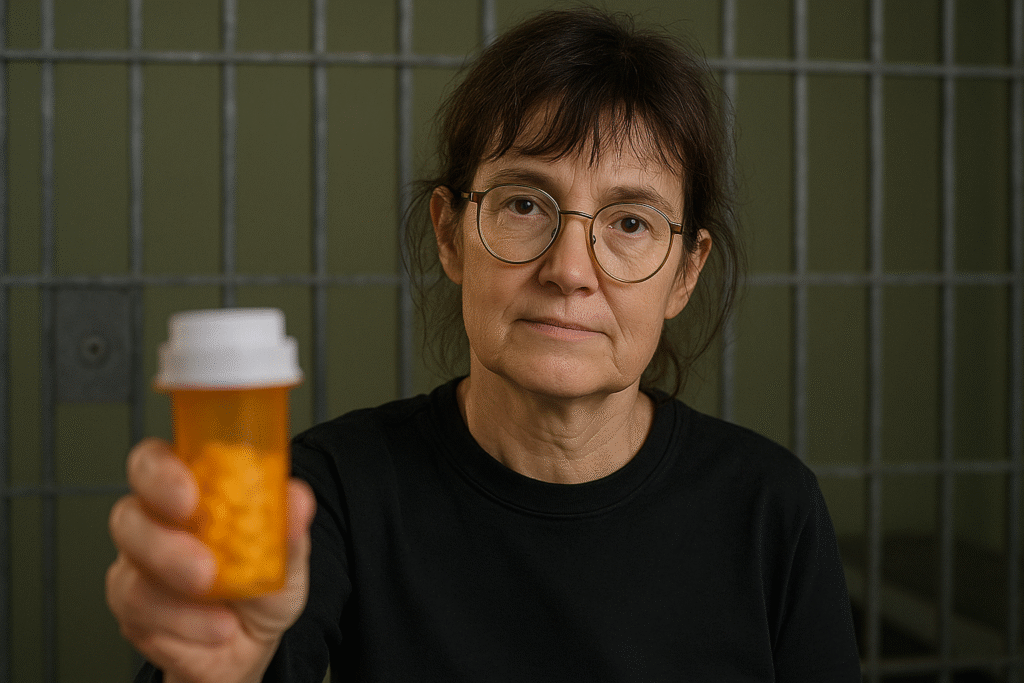
However, this is where the most difficult part begins. Prisoners are not allowed to keep medications with them. Twice a day, according to a strict schedule for each unit, women must come to a special distribution point, where a paramedic hands out the drugs.
“You see, when we come, we naturally have to take the medicine in their presence,” Natalia explains. “The medicine that we are supposed to take strictly there — after, before, or during [meals]. So, of course, we take this handful and swallow it all.”
She adds ironically: “If only the doctors who prescribed these medicines knew, the poor things, how I’m actually taking all of this here.” This practice nullifies individual prescriptions and may not only reduce the effectiveness of treatment but also cause harm to health.
The Subjective Factor: Exceptions That Prove the Rule
The system is not absolutely rigid. Natalia gives an example of when an exception was made for her. One medication she was supposed to take in the morning, and another in the evening. In order not to go to the medical unit twice a day, the doctor allowed her to receive the evening dose in the morning.
“That is, in my case it was possible,” she notes.
In addition, there is a practice whereby some “light” medications, such as vitamins, may be issued directly to prisoners by special permission so that they can keep them with them. However, these are rather exceptions that depend on the position of a particular doctor or the colony administration.
Expert Commentary: “This Is a Violation of Human Rights”
Physician and human rights defender Vasiliy Zavadski, who worked for many years in the penitentiary system, confirms that the ban on keeping medications is a general instruction. However, he is categorical in his assessment: this practice violates human rights.
“There is nowhere in the law that states a person is restricted in the right to have medications with them,” Zavadski explains. “Instructions are subordinate regulatory documents, and they must comply with higher-level documents such as codes or laws.”
According to the human rights defender, it is necessary to amend regulations and allow prisoners to keep at least the medications prescribed by their treating physicians, as well as those sold in pharmacies without a prescription.
The problem is aggravated by “subjectivism.” Vasiliy Zavadski notes that in some colonies, and in particular in women’s colonies, the administration sometimes makes concessions to prisoners, as was the case with Natalia Dulina. But in other institutions, a strict ban can lead to tragic consequences.
“In some colonies we know that it is not allowed, and then very serious consequences arise,” the expert says. “I know specific cases where people who were supposed to take regular, ongoing medication were deprived of that opportunity. As a result, the person suffered a stroke.”
According to Zavadski, this situation requires not individual permissions but clear regulatory rules that would guarantee every person’s right to timely and proper medical treatment, regardless of which side of the prison bars they are on.
Machine translation from Russian.