
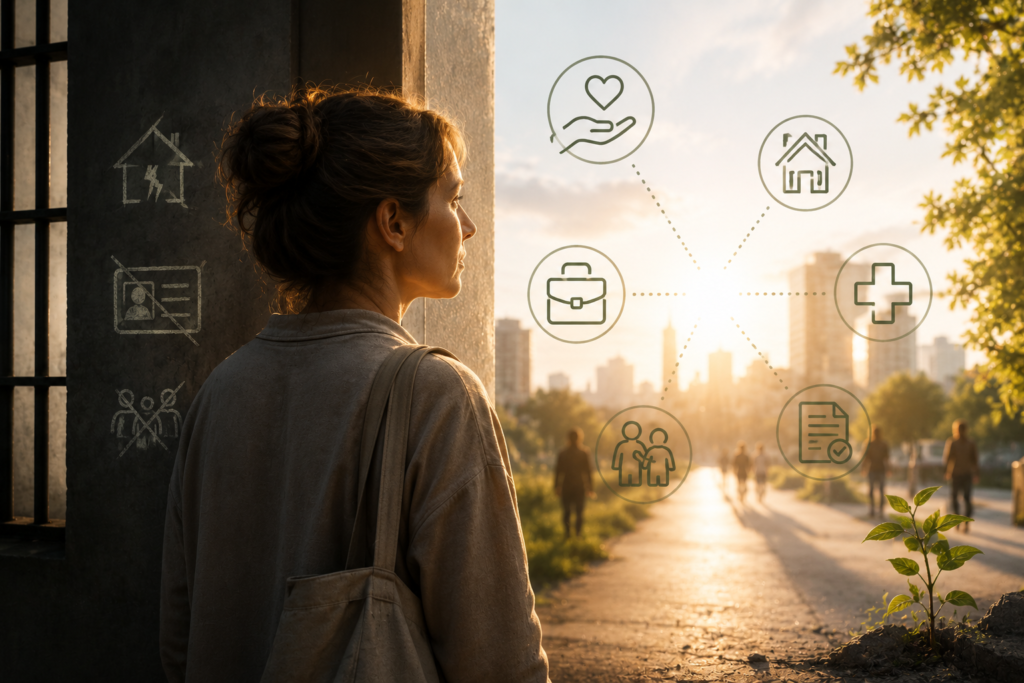
…A woman is released after years in prison, but she has no identity documents, no job, no family support, no access to medical care, and sometimes she also needs to rebuild her relationship with her children.
This is not a hypothetical reflection or an isolated case, but a typical web of problems that former female prisoners face in the first days and weeks following their release.
Today, we once again invite our website visitors to reflect on the issues surrounding the resocialization of women released from penitentiary institutions in Belarus.
We have repeatedly spoken and written about the grim figures of penitentiary statistics in Belarus.
One of the significant “red flags” in this area is the lack of transparency regarding information. Today, it is impossible to find official figures on the number of people held in places of detention in Belarus, which indicates that the Belarusian authorities have something to hide. However, we have sufficient indirect data, as well as expert competence, to independently estimate these indicators with enough accuracy for analysis.
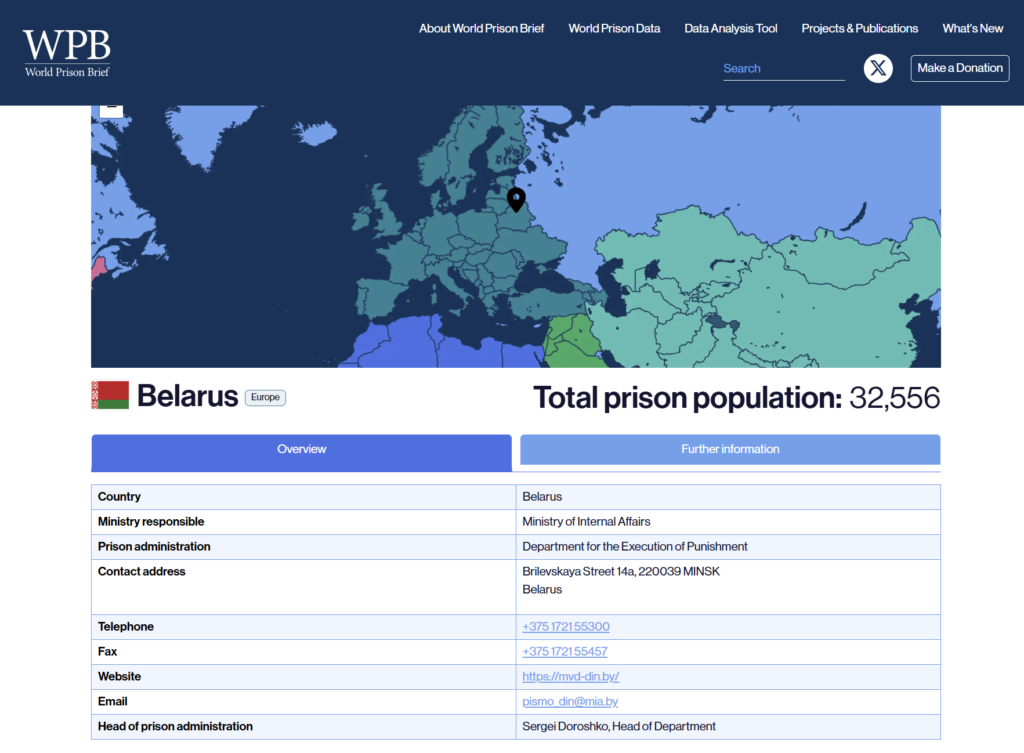
For instance, the Institute for Crime & Justice Policy Research, in the findings of its annual study, ranks Belarus 24th in the world in terms of the relative number of prisoners—345 people per 100,000 of the population (Image 1). And although the Institute honestly notes that the last reliable data for Belarus dates back to 2018, the events of the past decade, unfortunately, give no reason to believe that the number of prisoners in our country has decreased. We should also note that this figure typically excludes people held in pre-trial detention. Furthermore, the statistics do not account for a significant peculiarity of the Belarusian legal landscape: the existence of so-called medical-labor dispensaries, or LTPs (lyachebna-pracovyya prafilaktoryi). People held in LTPs are formally not considered convicts, although in practice they are deprived of their liberty, and these “dispensaries” themselves—despite being defined as “medical”—are part of the Department for the Execution of Punishments (DEP) system, a structure of the Ministry of Internal Affairs of Belarus. According to our estimates, taking this into account, no fewer than 40,000 people are currently held within the system of the DEP of Belarus.
Image 1.
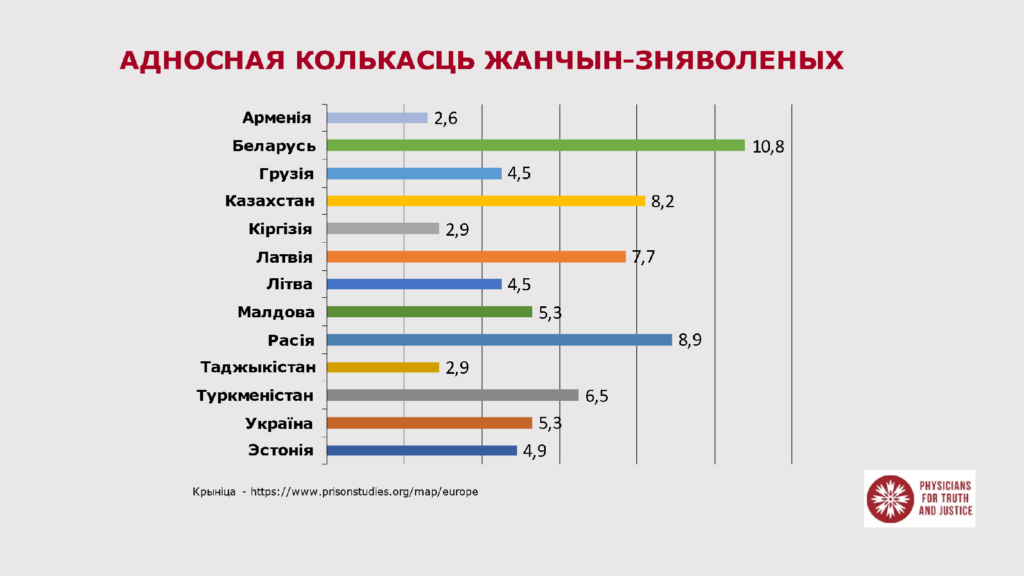
The data indicates that women make up at least 10 percent of the total number of prisoners in Belarus, and by this indicator, our country ranks approximately 13th in the world (Image 2). This aspect cannot fail to impress.
Image 2.
Logically, the main task of any country’s penitentiary system should be the prevention of recidivism—meaning systematic activities aimed at the successful reintegration of prisoners into society after release. And this is precisely what resocialization is. It is obvious that the gender aspect is of significant importance in this matter as well; that is, women have different needs for resocialization compared to men, and, accordingly, there must be different approaches to preparing them for release.
The problems of imprisoned women and girls as a whole remain under-researched. As for Belarus, data on contemporary systematic analysis of women’s needs for resocialization after release is virtually non-existent.
In 2015, human rights defender and former prison doctor Vasil Zavadski participated in organizing a scientific sociological study dedicated to the resocialization needs of prisoners in the Belarusian penitentiary system. Back then, it was still possible to conduct a large-scale survey of prisoners in several colonies, including female ones.
There is no reason to believe that the collected data has lost its relevance, so let us look at some examples.
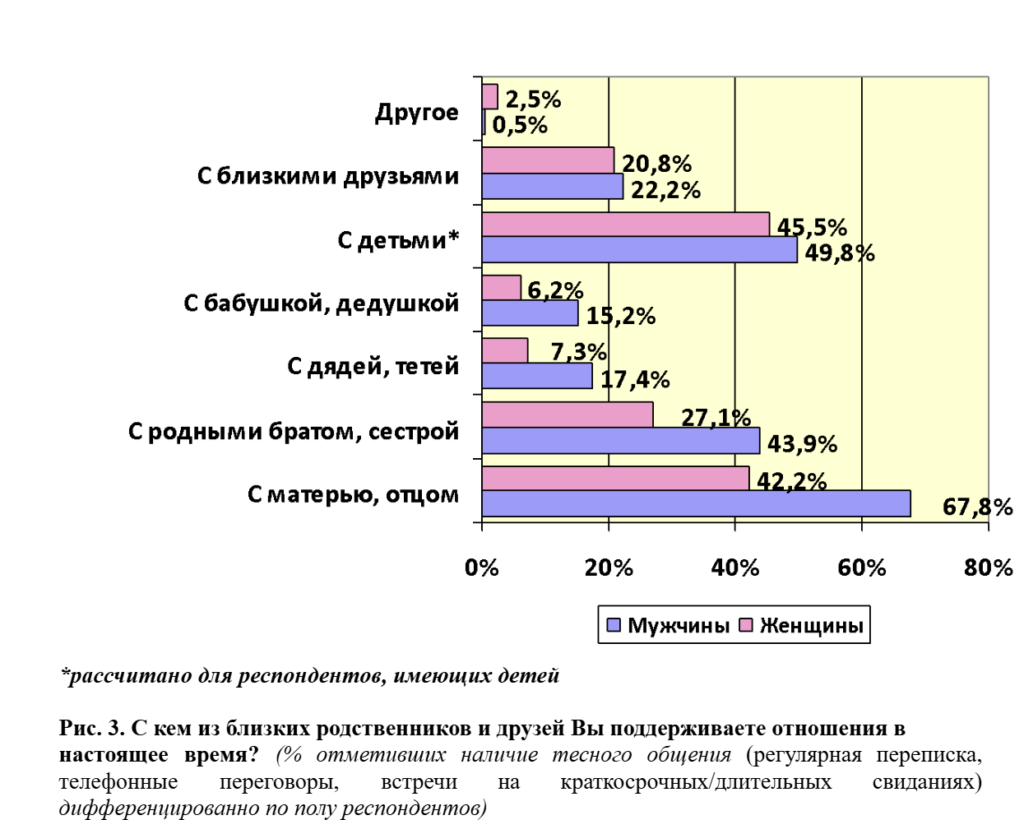
The first is information about the social ties that prisoners maintain during their imprisonment. Noteworthy is the fact that women have noticeably fewer contacts with people on the outside compared to men. See Image 3.
Image 3.
In general, 84.9% of surveyed prisoners require social assistance after release. The author of the study emphasizes that there is no noticeable statistical difference between women and men in this indicator.
The most requested forms of assistance are employment support (needed by 35.1% of respondents) and medical care (32.2%). 22.7% of respondents require the issuance/restoration of identity documents.
21.1% of those surveyed need help in restoring their parental rights—and in this indicator, women are clearly in the lead: such help is required by 48.8 percent of surveyed female prisoners compared to 14.1% of men. See Images 4 and 5.
Image 4.
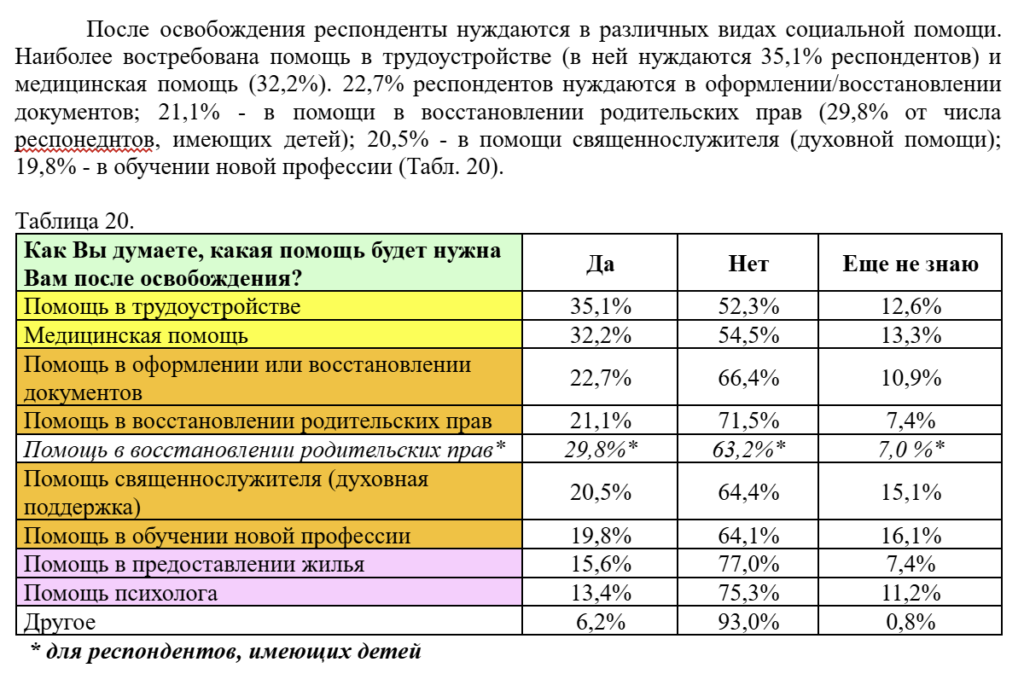
Image 5.
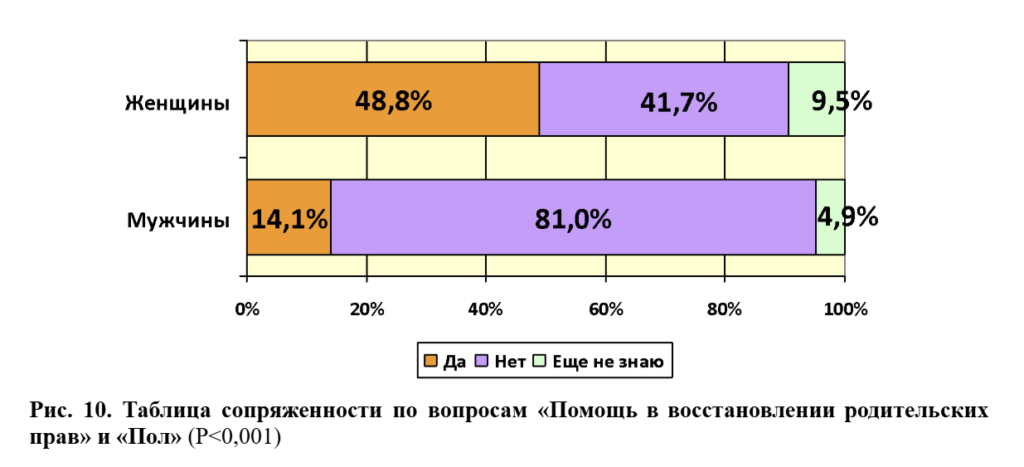
This data clearly demonstrates the need for targeted, serious, scientifically and practically grounded work to facilitate the resocialization of prisoners in our country—with a particular emphasis on the gender aspect of the problem. For women, this is especially important because for them, issues of social ties, health, motherhood, documents, work, and safety often intertwine into one complex knot.
Experience in such work exists, and it shows that this activity should be carried out throughout the entire time a prisoner serves their sentence and continue after release. Organizing this challenging work is the duty of the state, but it can only be effective when both state structures and society participate in it—through engaged individuals, and primarily through non-governmental organizations.
How this happens in practice in our country is shared by our interlocutors and our specialists. We continue to publish materials on this topic here, as well as on our social media pages.