









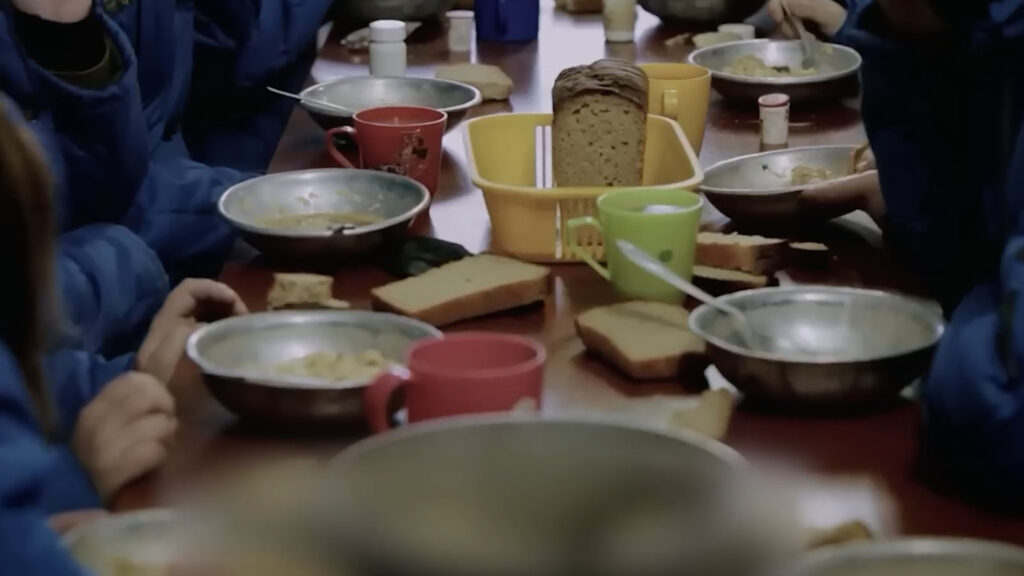
Assessments of food quality in the Belarusian women’s correctional colony vary significantly among former prisoners. For some, the food in the local canteen seems quite edible compared to the conditions in pre-trial detention centers (SIZO) and temporary detention facilities (IVS); for others, it is meager, consisting mostly of simple carbohydrates and not designed to support long-term health.
We spoke with “Viasna” human rights defender and former political prisoner Marfa Rabkova, as well as former political prisoners Valeria (name changed) and Volha (name changed). They shared how meals are organized and what everyday conditions women face in Penal Colony No. 4 in Homieĺ.
The Canteen and Menu Changes
Human rights defender Marfa Rabkova notes that the quality of food in the colony is noticeably higher compared to temporary detention facilities or pre-trial detention centers (such as “Valadarka”). Soups are described as carefully prepared, and the overall quality of food is characterized as adequate for places of detention.

Marfa Rabkova. Photo by Max Morrisson
“When I arrived at the colony, I remember my first lunch very well… I was delighted because I saw clear soup, and I had very good impressions. In fact, it’s simply a matter of comparison,” Marfa recalls.
According to former inmates’ observations, food quality and nutritional standards improved in 2021 (new state nutritional standards for correctional facilities were approved by Council of Ministers Resolution No. 169 on March 25, 2021). The prisoners themselves attributed this to the mass arrival of individuals convicted under political charges (the so-called “Category 10”). During this period, state standards for protein-to-carbohydrate ratios were raised, leading the administration to develop an updated menu.
Meals are organized at tables seating 10 people under the supervision of a duty officer. At the same time, portions of the most popular dishes are limited, while side dishes made of basic grains (barley, peas, buckwheat, oatmeal, rice) are provided in sufficient quantities. Taking bread out of the canteen is strictly prohibited by internal rules.
“Of course, sometimes [there were] issues with the amount of food, especially if it was something tasty—there was always somehow too little of it, while there was plenty of ordinary porridge,” shares Marfa Rabkova.
“The food? All carbohydrates and everything basic. The cheapest pearl barley, peas, buckwheat, oatmeal. Buckwheat once and rice twice,” recalls Volha.
“Basically, it’s food you can live on. Sure, you can’t say it’s fully nutritious or rich in vitamins. But at least compared to how it used to be—as the ‘old-timers’ tell it—the food now is much better. And generally, it’s edible,” says Valeria.
Features of the Prison Shop
Purchasing additional food items at the local shop is constrained by financial resources. Due to low manufacturing wages (which, after deductions for court claims, can range from a few kopecks to a couple of rubles a month), shopping is far from accessible to everyone.
“There were apples, but they could cost crazy money. Not everyone had enough money for them,” says Volha.
“When you earn one ruble for the month, you go to the store with that ruble. And you think long and hard about what to buy with those funds. You choose whether to buy a candy or an apple so that you get some ‘vitamins.’ That’s precisely because the brain wants a candy,” recalls Marfa.
The shop’s assortment has its own peculiarities. Fresh dairy products, vegetables, and fruits are delivered once a week and sell out quickly.
“When a person hasn’t eaten yogurt or cottage cheese for—excuse me—a year, of course they want it,” Volha believes.
Basic goods: On certain days, standard items like regular bread or hygiene products may be unavailable. Bananas are brought in extremely rarely.
“I kept track of the statistics. Over a year, I was lucky enough to buy bananas once. There were bananas in the shop just one single time, and they happened to go to our unit,” says Volha.
Additional items: Occasionally, items rare for such conditions appear on the shelves (mangoes, coconuts, avocados, hummus), priced beyond the reach of most prisoners.
“For example, it was comical at times: you come to the store, there’s no bread, no toilet paper, but there’s coconut, mango, and avocado,” recalls Marfa.
Rationed goods: Sugar sales are capped at 1 kg per person per month. Due to tight budgets, women who smoke often choose to forgo sugar in favor of tobacco products.
Parcels, Certificates, and Storage Conditions
For prisoners with outside support, parcels play a vital role (with an established limit of 50 kg once every three months). Splitting the allowed 50 kg into multiple smaller parcels within a single permitted period is forbidden. If a 15 kg parcel is sent instead of 50 kg, the right to that allowance is considered fully used, and the next one will only be permitted according to the schedule. To maximize nutritional value, parcels typically include walnuts, dried apricots, rye crispbreads, and candied ginger. Accepting parcels from unauthorized third parties is prohibited.
“I simply optimized the food to such a degree (referring to parcels—Ed.) to get something truly nutritious. That meant I had a lot of nuts (mostly walnuts), dried apricots, rye crispbreads (like croutons), and lots and lots of candied ginger. Everything was dried because it’s lighter and you can pack more of it into that 50 kg parcel limit,” Valeria shares.
Relatives can also pay for a gift certificate via the official website of the colony’s online store. This allows purchasing goods in the shop against the parcel weight allowance, including items prohibited from postal delivery (such as dairy products). However, redeeming a large certificate within the allotted timeframe of approximately three days can be difficult due to limited shelf inventory.
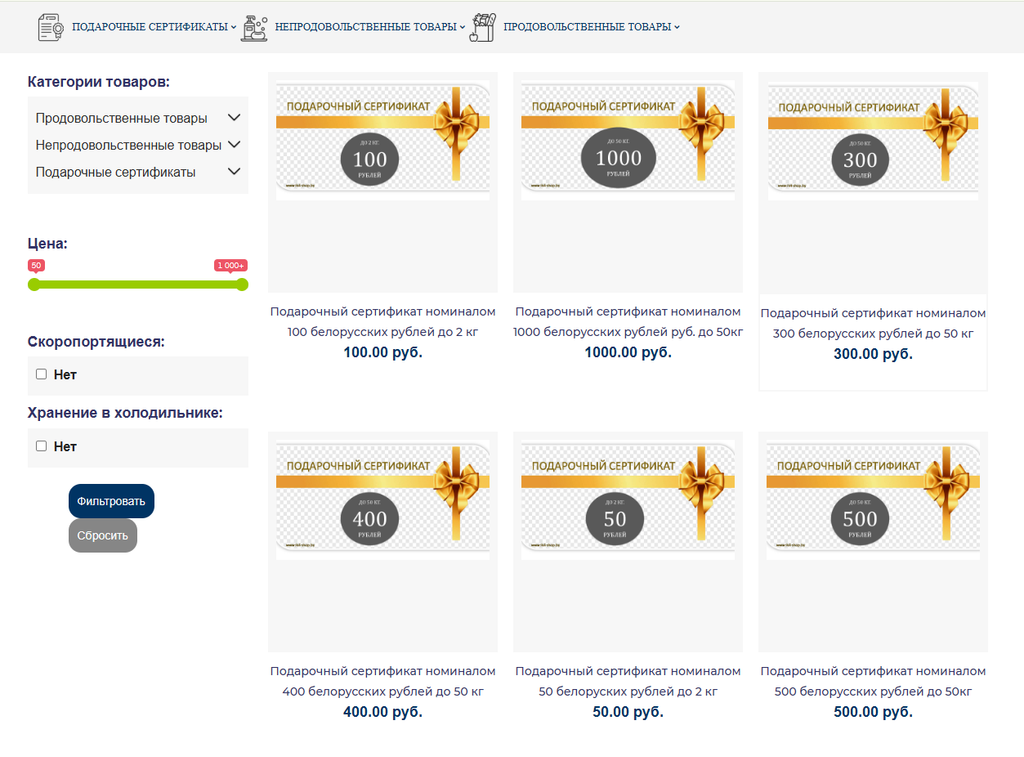
Screenshot of gift certificates from the online store of Penal Colony No. 4
A separate issue concerns food storage. For a unit of about 100 people, only two refrigerators are provided, used by approximately 60 people. To distribute space rationally, prisoners self-impose limits (e.g., no more than two yogurts per person).
“If you are in a ‘wealthier’ unit, there’s naturally a shortage of fridge space. You could go buy a lot of dairy products, but you’d simply have nowhere to put them. In some units, this is regulated internally. They agree among themselves that everyone buys only two yogurts. Because if all one hundred people buy five bottles of yogurt each, storing them there becomes physically impossible,” says Marfa.
Shop Visit Rules and Restrictions
The procedure for visiting the shop is regulated by the colony administration. In particular, political prisoners (“Category 10”) are often sent to shop last, when choices are limited and available fridge space is already taken. In such cases, purchased perishable items must be consumed immediately or stored at room temperature.
According to human rights defender Marfa Rabkova, parcel items are stored in special supply rooms (kaptiorkas) in cardboard boxes. Time limits may be placed on storing fresh fruit: for instance, a received shipment of 20 kg of apples and citrus fruits sometimes must be consumed within three days. Operational staff use storage rules as a tool of psychological pressure. An officer might intentionally keep extra storage cubbies in the supply room empty, forbidding prisoners from placing their food there.
Internal regulations also strictly forbid transferring food between prisoners (termed “alienation and appropriation”). Violating this requirement results in disciplinary reports, ruling out any official support for those who do not receive parcels from the outside.